San Marcos Elite Concrete works as a concrete contractor in Seguin, and most of what we are asked to look at here was poured a long time ago. Original flatwork on a meaningful share of this city is somewhere between fifty-five and ninety years old, which makes repair and replacement the core of the trade here rather than new placement.
That is a different trade from new construction. The question is rarely what to build; it is what is left in what is already there, and whether the money is better spent repairing it or removing it. Answering that honestly takes a measurement rather than an opinion, and it is where a lot of homeowners here get sold the wrong thing.
The other thing worth knowing before you buy anything in Seguin is who owns which part of the concrete in front of your house, and what the city requires of anyone working in the right-of-way. Both are written down, and both change what a quote should say.
What Ninety-Year-Old Concrete Looks Like When It Goes
Wear at the Surface Against Failure Through the Slab
The scale of it is worth stating: about 28.2 percent of Seguin’s 13,397 housing units predate 1970 and 9.7 percent predate 1950, so a great deal of the concrete in front of these houses is original to them.
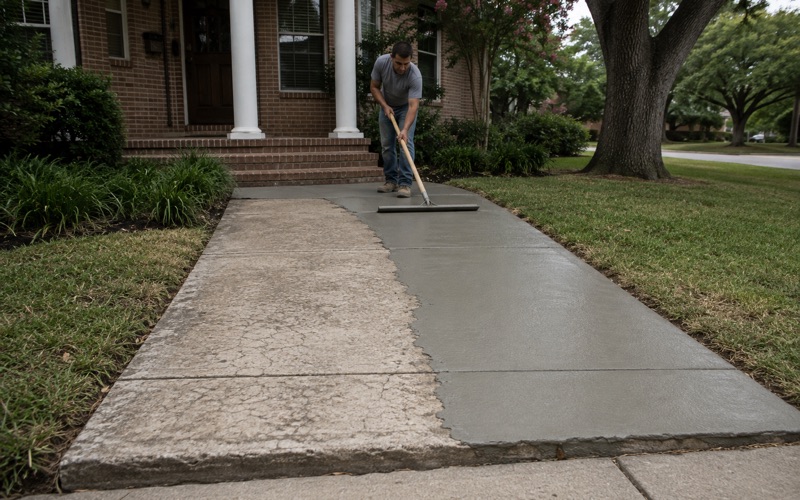
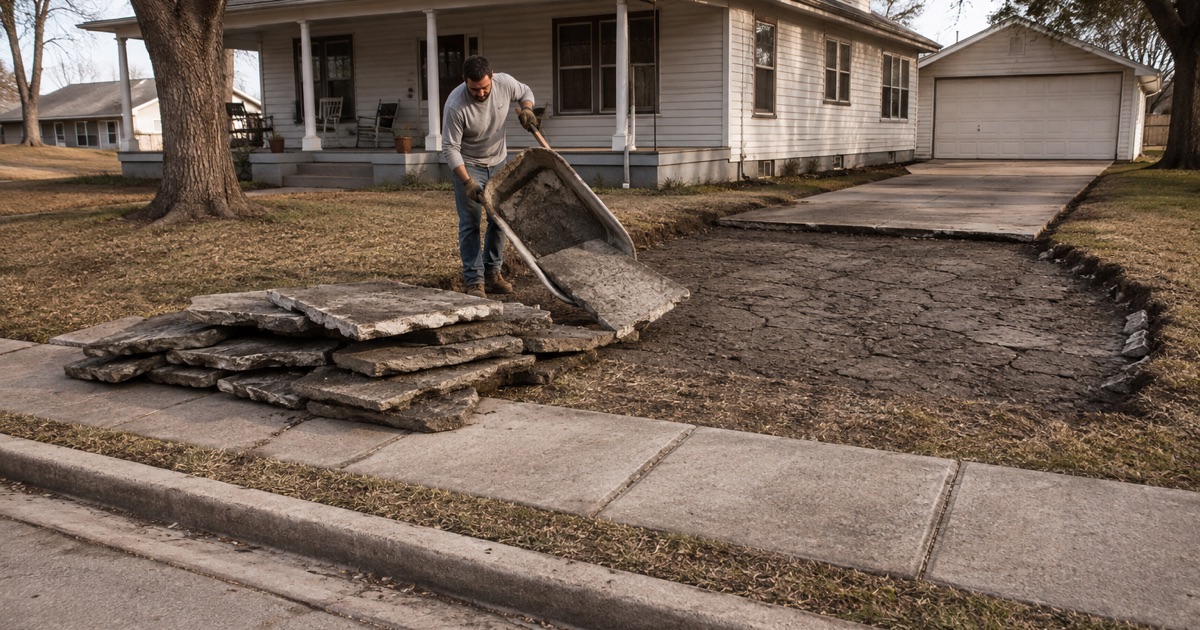
Old concrete usually announces itself at the surface first: scaling, spalling, a powdery worn texture, exposed aggregate where the paste has gone. None of that necessarily means the slab is finished. Concrete of that age was frequently placed thicker than modern residential work and can be structurally sound under a poor surface.
What does mean it is finished is failure through the depth: cracks that pass full thickness and offset vertically, panels that rock underfoot, or a slab broken into pieces that move independently. We check for those specifically before recommending anything, because the outward signs of the two conditions look far more similar than they are.
Joints That Have Stopped Being Joints
On flatwork this old, the joints are often the actual problem. Sealant has long gone, the joint has filled with debris, and the panels are effectively locked together, so movement relieves itself somewhere new rather than where it was meant to.
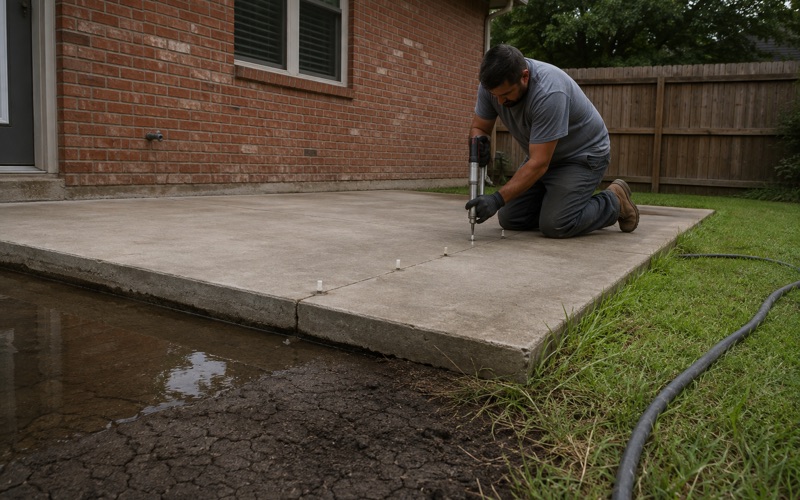
Reinstating joints on an otherwise sound slab is a genuinely cheap intervention with a disproportionate effect. We clean out and reseal rather than filling over, use backer rod where the joint depth calls for it, and cut new joints where the original spacing was too generous for the slab that is there.
Reinforcement, or the Absence of It
A lot of older residential flatwork here has no reinforcement at all, and some has mesh that spent its life lying on the base doing very little. That matters for the repair decision, because an unreinforced slab that has cracked has no mechanism to hold those cracks tight.
We say plainly when that is the situation. It does not automatically mean replacement, but it does mean that patching a crack is cosmetic rather than structural, and it changes how long any repair should be expected to last. Knowing that before you spend is the difference between a fair result and a disappointment.
Looking for concrete-contractor closer to McQueeney? See Concrete-Contractor Services in McQueeney.
Deciding Between Repair and Replacement
Putting the Numbers on the Table
Repair and replacement get compared with published figures rather than with a rule of thumb about how much of the slab is cracked. Partial depth repair, crack chasing, epoxy injection, grinding and overlays each have a range where they are the better buy, and a point past which tear out and repour is cheaper over the life of the surface.
We show you where your concrete sits on that line and include the option of doing nothing where it is defensible. On flatwork this old, a considered decision to spend nothing for two more years is sometimes the correct answer, and it is not one a contractor paid by the pour will usually volunteer.
Partial Replacement and Matching Into Old Concrete
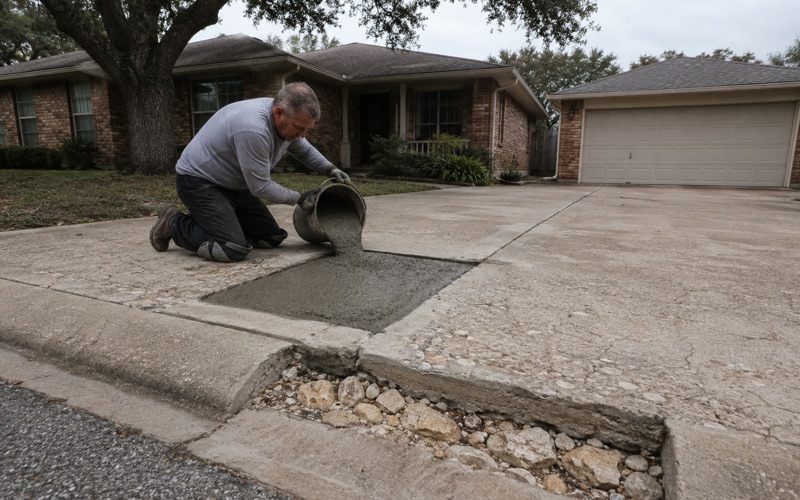
Replacing the failed panels rather than the whole run is often the sensible middle course, particularly on a long drive or walk. The join gets an isolation joint rather than a bond so old and new move independently.
Color will not match at first, and on concrete this old it will never match completely, because decades of weathering are not something new concrete can imitate. We match texture, joint spacing and panel dimensions so the repair reads as part of the surface, and we say up front what the appearance will be rather than letting you discover it.
Where the Old Concrete Goes
One practical Seguin detail that catches contractors out: concrete is on the city’s unacceptable-waste list for franchised commercial collection. Sec. 86-112 lists tires, concrete and bulk petroleum or chemical products among unacceptable waste, so demolition concrete cannot be put into a franchised commercial container here.
That means disposal is a real line in a replacement quote rather than an assumption, and it is one reason removal costs what it does. We haul to a proper destination and price it openly instead of burying it, and on larger jobs we will tell you where crushing for reuse on site is a legitimate saving.
The Apron Is Yours, Including Where It Meets the Sidewalk
What Sec. 90-68 Actually Says
Seguin’s code is unusually direct about this. Sec. 90-68(b) provides that property owners shall be responsible for maintaining their driveway aprons, including the portion of the driveway apron that is integrated with the sidewalk.
That last clause is the part people do not expect. The apron and the sidewalk are treated as continuous where they meet, so the piece of concrete a pedestrian walks across in front of your drive is your maintenance obligation rather than the city’s. We scope repairs to include it rather than stopping at an imaginary line.
The Parkway Strip and Damage Caused on Your Behalf
Within the city, the parkway strip between the property line and the curb line is the abutting owner’s to maintain, including where no curb exists. Public sidewalks may not be removed or damaged, and an owner, tenant or lessee is responsible for damage caused by anyone working on their behalf.
Failing to restore streets and sidewalks damaged during construction within a reasonable time after the rest of the work finishes is unlawful. That is worth knowing when any trade works at your frontage, not only when the job is concrete, because the obligation follows the property rather than the contractor.
Permits, Insurance and a Two-Year Warranty
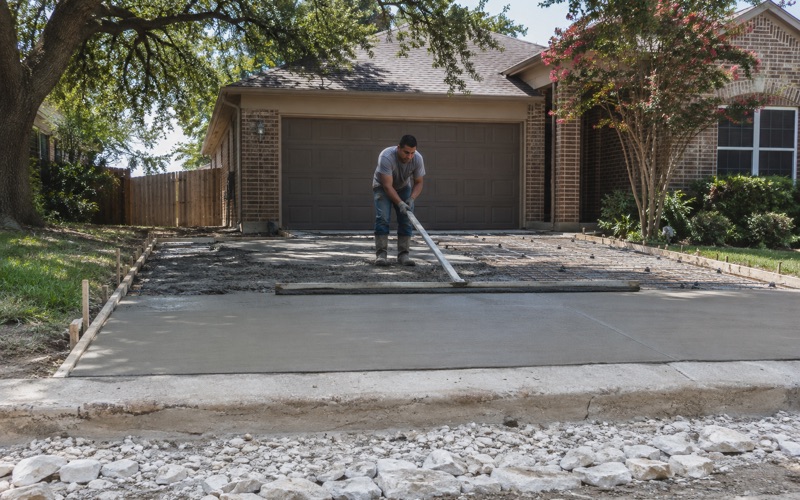
Anyone building a curb, driveway or sidewalk on a right-of-way needs a city permit. Right-of-way work permits require a million dollars of comprehensive general liability for property damage per occurrence and the same per person and per occurrence for bodily injury or death, plus workers compensation with employer’s liability of at least a million per occurrence.
Work in the right-of-way also carries a warranty by ordinance: each permit applicant executes an undertaking to warrant the work for two years following completion. A homeowner working on their own owner-occupied homestead is exempt from the insurance requirements but must name the city as an additional insured with waiver of subrogation under their own policy.
The Five-Year and Pavement Condition Index Rule
There is one rule here that can stop a job before it starts. No right-of-way excavation permit will be issued in a public way constructed, reconstructed, repaved or resurfaced in the preceding five years, or one carrying a pavement condition index of 85 or greater.
The city engineer may allow an exception for good cause, and may require additional soil compaction test reports and special paving as a condition of it. We check the street’s status before designing an approach that depends on cutting into it, because finding out afterward means either a redesign or a request that may not be granted.
The Ground Under Seguin
Branyon Clay at a Plasticity Index of Forty-Three
Branyon clay on 0 to 1 percent slopes covers 28.69 percent of the city, with a further 4.80 percent on 1 to 3 percent slopes. The Branyon component is a Vertisol carrying a representative 53 percent clay, a plasticity index of 43, a liquid limit of 69 and linear extensibility of 13 percent.
Thirteen percent is at the high end of the range, and it describes a soil column that measurably changes length between wet and dry. Roughly 37.1 percent of the evaluated city sits on soil whose representative linear extensibility is 9 percent or greater, so this is genuine high-movement ground rather than a regional generalization.
Barbarosa, and Why a Citywide Claim Is Wrong
The second-largest unit behaves very differently. Barbarosa silty clay on 0 to 1 percent slopes covers 19.90 percent of the city and is a Mollisol with 50 percent clay and a plasticity index of 35, but linear extensibility of only 7.5 percent.
Two of the largest units in Seguin therefore differ by nearly a factor of two in movement potential, which means a citywide statement about slab movement is wrong at parcel scale. Sunev loam on the southern river terrace covers a further 3.23 percent at just 1.5 percent extensibility. We check the mapped unit for your address rather than applying one design across town.
Clay, Not Rock, and Where Water Sits
Excavation here is a clay problem rather than a rock problem. Only about 4.3 percent of the evaluated area has a root-restricting layer within 50 centimeters, and no map unit in the city carries rock outcrop as a named component, so hammer days are rare and volume is the cost driver.
Two named flooding-phase units, Seguin silty clay loam and Tinn clay, cover about 4.9 percent of the city between them. On those and on the flatter Branyon ground, surface falls have to do the drainage work, so we set grades deliberately and keep roof and yard water away from slab edges rather than trusting it to soak away.
- 20+ Years in Business
- Insured
- Free Written Estimates