San Marcos Elite Concrete works as a concrete contractor in Kyle, and the single most useful thing we can tell a Kyle homeowner is where the rules for their driveway actually live. They are not in the code of ordinances. They are in a checklist the Building and Code Services department publishes, and it is specific enough to fail a pour that would pass almost anywhere else in this service area.
That document is the Residential Driveway and Sidewalk Standards and Checklist, effective January 1, 2025, and it carries the strength, thickness, reinforcement, bedding and joint requirements outright. A contractor who has not read it will quote what they normally build. In Kyle, what they normally build is frequently not what will be accepted.
Twenty years on this corridor has taught us to read the local document before pricing anything, and Kyle is the clearest case for it. The other half of a Kyle job is the ground, which is not what most people assume, and where your lot sits relative to the Edwards Aquifer Recharge Zone, which changes the paperwork before earthwork starts.
The Kyle Driveway Specification, Line by Line
Five Inches Through the Approach, Not Four
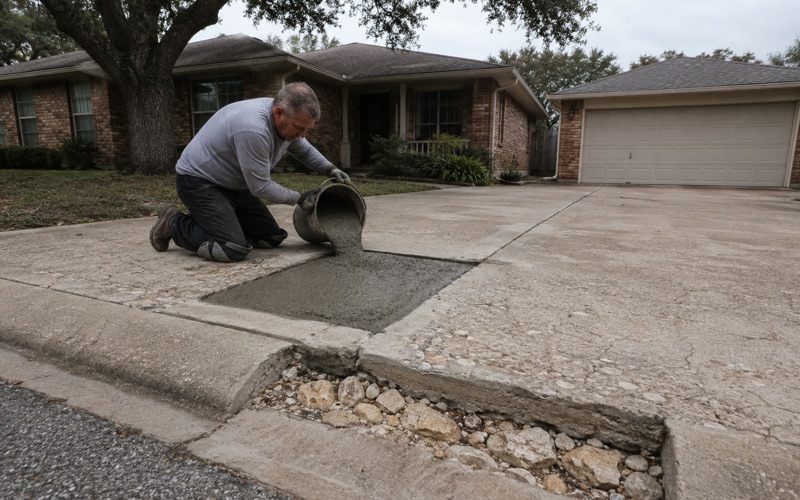
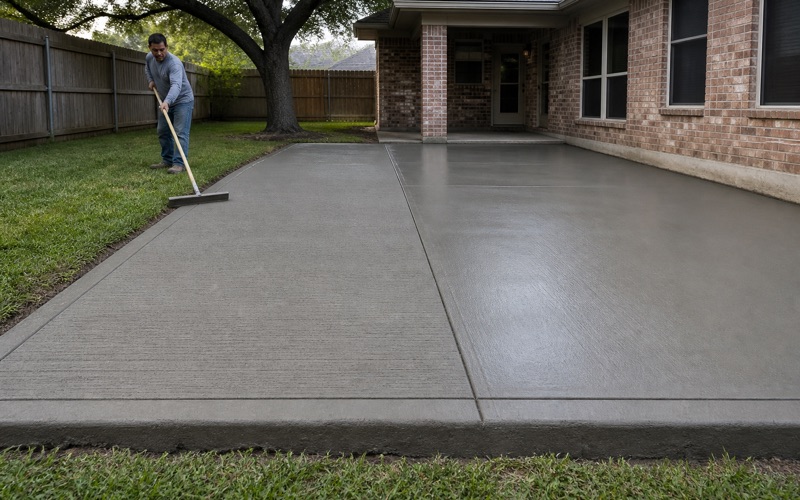
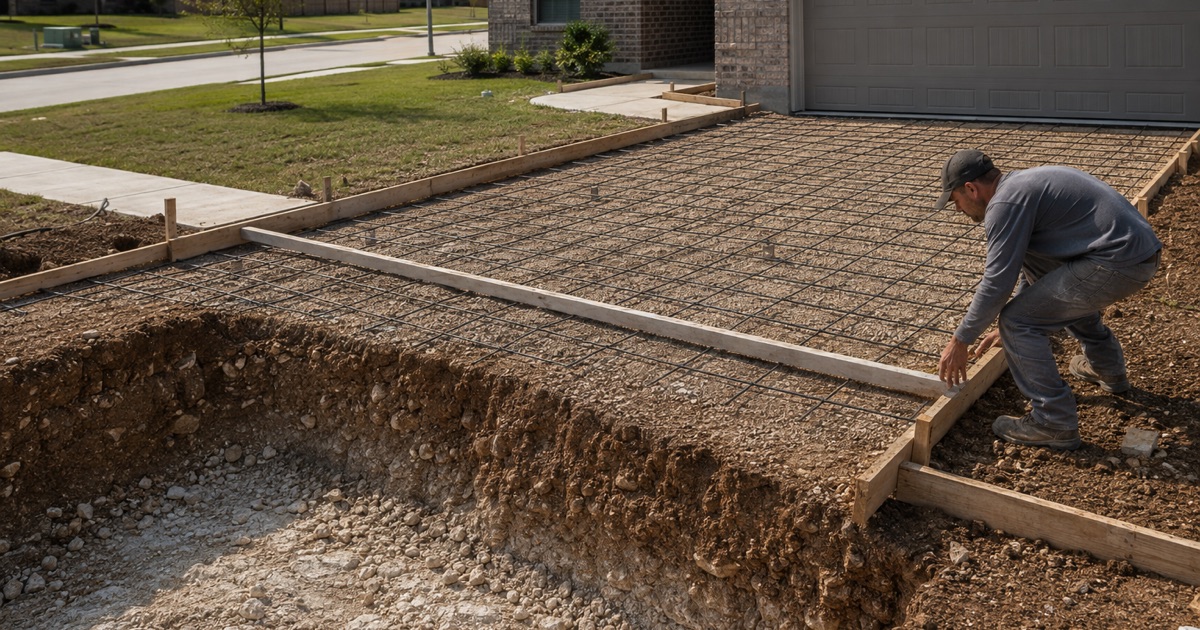
Kyle requires a minimum of five inches of concrete throughout the approach. Four inches is the residential default across much of Texas, and it is the figure a bid written from habit will carry, which makes this the most common way a Kyle driveway quote comes in low and then has to change.
That extra inch is roughly a quarter more concrete through the approach, so it is a real cost rather than a technicality. We price it correctly from the start and show it on the quote, because a number that has to be revised after the checklist is read is worse than a higher number that was right the first time.
3,000 psi Class A Concrete
The checklist is explicit that concrete shall be minimum Class A with a compressive strength of 3,000 psi. That is a specification on the mix rather than on the finish, and it is verifiable after the fact from the ticket for each load.
We order to the specification and hand you the delivery ticket for every truck, which carries the machine stamped batch time and date, the weights of cement, fly ash, sand and aggregates, and the admixture names and quantities. An incomplete ticket is grounds to reject the load, and a load rejected at the curb is far cheaper than a slab argued about later.
Number Three Bar at Eighteen Inches, on Chairs, at Mid-Depth
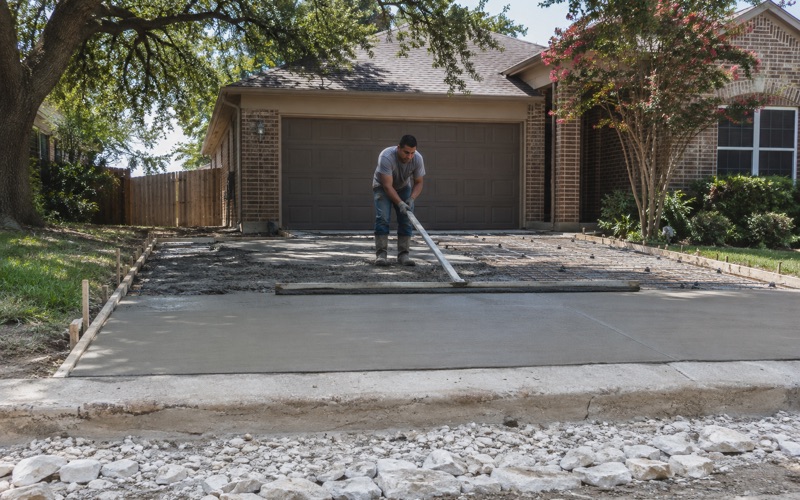
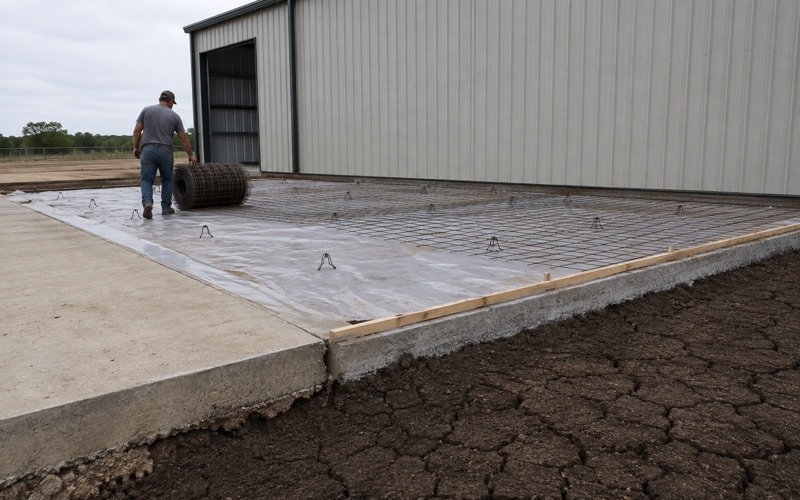
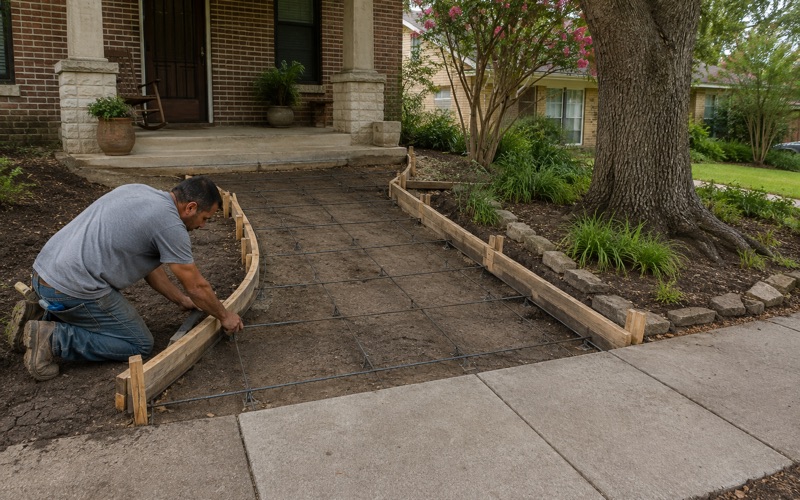
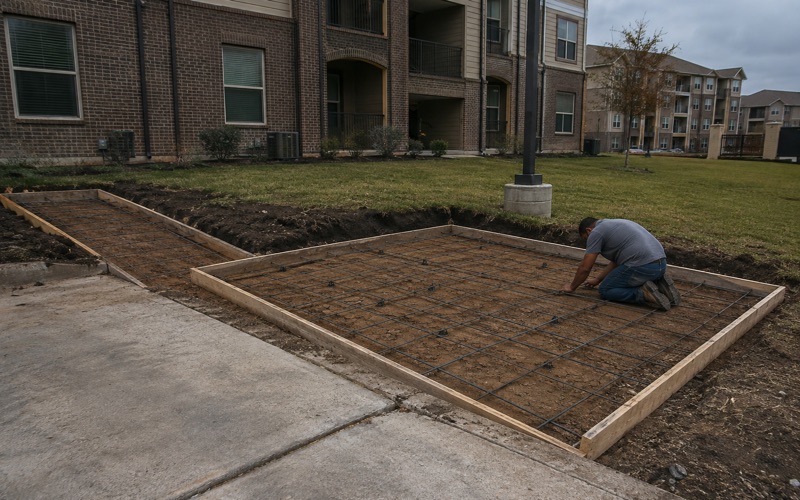
The reinforcement requirement is precise: number three rebar at eighteen inches on center, placed on chairs at mid-depth of the concrete. All three parts of that matter, and the last one is where most work fails, because steel that ends up sitting on the base does nothing for the slab above it.
We tie the mat, chair it properly and check it before the truck arrives rather than pulling bar up through wet concrete with a hook. It is also what the inspection is looking at, which brings us to the part of the checklist that surprises people most.
Looking for concrete-contractor closer to Geronimo? See Geronimo Concrete-Contractor.
The Four Substitutions Kyle Will Not Accept
Hog Panels, Wire Mesh and Fibrous Concrete
The checklist rules these out by name: hog panels, wire mesh and fibrous concrete are not permitted in place of the specified bar. Each of them appears regularly in residential driveway work elsewhere, and macro synthetic fiber in particular is a legitimate product for controlling plastic shrinkage cracking.
None of that matters here. Kyle has decided what it will accept, and a driveway reinforced with any of the three is a driveway that fails inspection. We quote the bar because the bar is what is permitted, and we will explain the alternative rather than quietly substituting it.
Bricks and Rocks Used as Chairs
The checklist also states that broken pieces of brick, rock or similar materials will not be accepted in lieu of chairs. This is the shortcut that most often shows up on a low bid, because chairs cost money and rubble is free.
The rule exists because rubble does not hold bar at a consistent depth, which puts steel at the wrong height across the slab and makes the specified mid-depth placement meaningless. We use proper chairs at the spacing the mat needs, and the difference in cost is small enough that nobody should be taking the risk.
Bedding, Joints and Where the Drive Can Go
Two inches of sand or other approved material is required for bedding, and expansion joints of half-inch pressure preservative treated lumber, asphalt board or naturally moisture resistant lumber go in the center of any driveway wider than twelve feet. Widths run from a twelve-foot minimum for single-family homes to a twenty-five foot maximum.
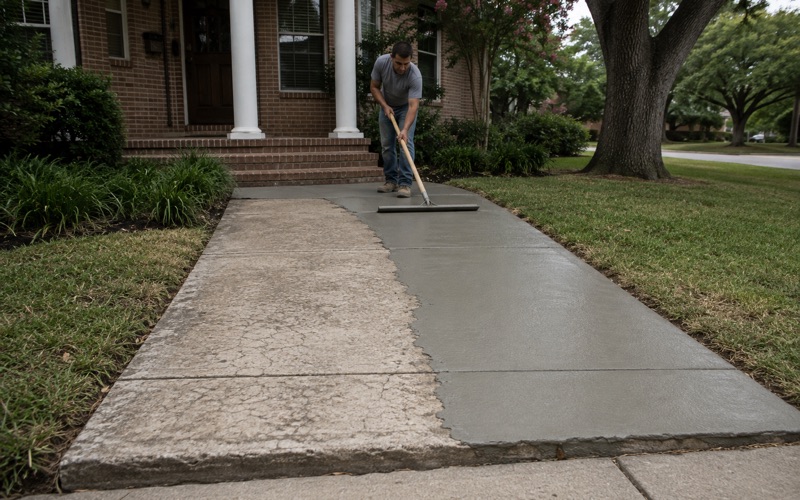
Placement is constrained too. A driveway may not sit within ten feet of a storm sewer inlet, and water meter boxes, water main valves and wastewater cleanouts may not fall inside it. The pedestrian crossing section has to transition into the sidewalk with no change in elevation greater than a quarter inch, which is a tighter tolerance than most people expect.
Two Inspections, Not One
Kyle inspects flatwork twice. A right-of-way inspection for sidewalks and driveways has to be scheduled through the portal before the pour, and a further inspection happens at the final building inspection, where the work is expected to be in good condition and meeting Texas Accessibility Standards slope requirements with no significant cracking or crazing.
Having the driveway and sidewalk inspected separately generates an additional fee, so they should be ready together. We schedule around both inspections rather than treating the first as the finish line, since work that passes before the pour and crazes afterward is still work that has to be dealt with.
What Is Actually Under Kyle
Limestone and Chalk First, Clay Second
The assumption people bring to Central Texas is deep black clay everywhere, and in Kyle that is the smaller share. SSURGO clipped to the city polygon puts Mollisols under 52.0 percent of the city against Vertisols at 39.6 percent, with limestone-derived residuum the single largest parent material at 20.7 percent.
Chalk is a named parent material here and it is not marginal: 5.8 percent of the city’s soil components formed in residuum weathered from chalk and a further 5.0 percent in residuum weathered from the Austin chalk formation. Real gravelly loam on 1 to 8 percent slopes covers 11.18 percent, and its representative linear extensibility is 1.0 to 2.1 percent, which is barely moving ground.
Where the High-Movement Clay Actually Is
The swelling clay is concentrated rather than absent. Houston Black clay on 1 to 3 percent slopes covers 11.81 percent of the city with a plasticity index of 44 and linear extensibility of 12.0 percent, and Heiden appears in three slope classes totaling around 13 percent, all with a plasticity index of 40.
Kyle also carries Heiden on grades as steep as 5 to 8 percent, eroded, which is high-plasticity clay on real slope rather than on flat prairie. The practical consequence is that we price the ground per lot here rather than per city, because two Kyle addresses can need genuinely different excavation, thickness and joint spacing.
Foundation Repair Is Engineered, and the City Says Why
Kyle requires a permit for foundation repair, requires the foundation company to be registered with the city and to pull that permit, and requires an engineered design because of the expansive soils in Kyle, with a sealed letter from the engineer approving the work at inspection.
That is worth knowing before you buy a repair, because it rules out the same-day, no-paperwork option some outfits offer. Where we are looking at movement rather than flatwork, we will tell you plainly that the path runs through an engineer rather than through us.
The Edwards Aquifer Recharge Zone Runs Through Kyle
A Quarter of the City, and Not Where People Assume
Measured on a lattice of 3,495 points inside the city polygon, 26.5 percent of Kyle falls in the Edwards Aquifer Recharge Zone, 21.4 percent in the Transition Zone and 5.8 percent in the Contributing Zone within the Transition Zone, with 46.3 percent in none of TCEQ’s four mapped zones.
The boundary runs through the city rather than around it, and a single point tells you nothing about a lot on the other side of town. That is exactly why we check the specific address against the zone layer instead of applying one answer citywide.
What Being on the Recharge Zone Changes
The Recharge Zone share is a regulatory fact rather than a geological description. TCEQ’s Edwards Aquifer Protection Program attaches plan-approval requirements to regulated activities on the Recharge Zone that do not attach off it, so which side of the line your site sits on changes the paperwork before any earthwork starts.
We identify that at quote time and say what it means for your schedule. TCEQ’s legally official map for this area is the scanned San Marcos North quadrangle sheet, USGS number 29097H8, and the digital polygons are a representation of those sheets rather than a replacement for them.
Groundwater Districts Are a Different Object Entirely
There is a second boundary through Kyle that gets confused with the first. The Barton Springs-Edwards Aquifer Conservation District’s original territory, set by Senate Bill 988 in 1987, ran from south of the Colorado River in Austin to northern Kyle, and House Bill 3405 added a shared territory in 2015 extending from northern Kyle to southern San Marcos.
A groundwater conservation district regulates wells and groundwater production under Chapter 36 of the Texas Water Code. A TCEQ zone attaches plan-approval requirements to construction activity on the surface. A site can sit inside one and outside the other, so when we tell you what applies to your slab, we name which object we mean.
- 20+ Years in Business
- Insured
- Free Written Estimates