San Marcos Elite Concrete works as a concrete contractor in Buda, where the ground is not one story and a price built on the wrong half of the city will not hold. More than twenty years of flatwork along the Interstate 35 corridor between Austin and San Antonio stands behind that, across two building markets and four counties rather than one set of rules.
We price the ground before we price the concrete. A bid built on an assumption about what sits below the topsoil gets revised the moment the excavator arrives. That is how a homeowner ends up paying for someone else’s guess.
What follows is the reasoning, then how we handle reinforcement, joints, the mix, the ticket and the permit side of a pour here. Every figure comes from the published soil survey or the city’s own code, not from a rule of thumb carried in from another town.
Why a price from one side of the city does not transfer
Two soil orders under one small city
Clipped to the Buda place polygon, the SSURGO survey puts Vertisols under 46.3 percent of the city and Mollisols under 37.9 percent. A Vertisol is a deep shrink-swell clay that changes dimension with moisture. A Mollisol as mapped here is shallower, more calcareous and closer to rock.
The survey area is TX604, and thirty-five map units fall inside the city limits. That is a lot of variation for a place this size. Two houses a few streets apart can need two different builds.
The parent material splits the same way
Of the city’s named soil components, 42.8 percent formed in mudstone, shale or claystone residuum and 35.5 percent in limestone, chalk or marl. Another 7.9 percent formed in alluvium. Mudstone residuum weathers into deep plastic clay, while limestone residuum leaves thin soil over something hard.
Parent material predicts what the excavator meets and what the slab bears on at once. On most jobs those are two separate questions, and narrowing both before anyone writes a number down is most of the work.
What the split does to a quote
A quote covers excavation, base, reinforcement, thickness and joint layout, and the ground moves every one of those lines. On the clay side the money goes into controlling movement, and on the limestone side into reaching a founding depth. Averaging the two is wrong in both directions.
So we do not quote off a rate applied to an address. We quote off what the site assessment finds, which is why a neighbor’s price is a poor guide inside the same subdivision.
Looking for concrete-contractor closer to Lockhart? See Concrete-Contractor Services in Lockhart.
The deep-clay half, and Heiden across a fifth of the city
Heiden clay and a plasticity index of 40
Heiden clay on 3 to 5 percent slopes covers 14.25 percent of the city and Heiden on 1 to 3 percent slopes another 8.17 percent. The component carries a representative plasticity index of 40, liquid limit 60 and 50 percent clay to 147 centimeters. Linear extensibility runs 12.0 to 12.2 percent through that depth.
Linear extensibility is the number we design against, because it states how far the material moves between wet and dry. Twelve percent is a great deal to put under something rigid. Conductivity of 0.21 micrometers per second means the water driving that movement also leaves slowly.
Houston Black and Branyon beside it
Houston Black clay on 1 to 3 percent slopes covers 13.09 percent of the city at plasticity index 44, liquid limit 70, 54 percent clay and 12 percent linear extensibility to 178 centimeters. The component table records no lithic or paralithic restriction there, so every decision falls to the slab and its base.
Branyon clay covers 4.78 percent at 0 to 1 percent slopes and 1.43 percent at 1 to 3 percent, rising from plasticity index 39 at the surface to 43 below. Tinn clay adds 3.41 percent of frequently flooded bottomland clay at plasticity index 41. With Heiden, that is most of the deep-clay half of town.
Krum, where the plasticity index alone misleads
Krum covers 14.3 percent of the city across two map units and is why we never quote from one test figure. It carries plasticity index 31 to 34 and 45 to 50 percent clay, which reads like the Vertisols beside it, but linear extensibility of only 7.0 to 10.3 percent, because the profile runs 8 to 35 percent calcium carbonate.
The plasticity index alone would put Krum in the same bracket as Houston Black, and the shrink-swell figure says otherwise. Krum formed in calcareous alluvium derived from limestone and drains at 0.9 to 1.2 micrometers per second.
The limestone edge, and what changes when rock comes up
Thin soil over weathered bedrock
Doss silty clay covers 5.77 percent of the city with weakly coherent paralithic bedrock at a representative 43 centimeters. The Austin-Castephen complex covers 3.64 percent, with bedrock at 61 centimeters under Austin and 46 under Castephen, both over Austin chalk at plasticity index 28 to 35.
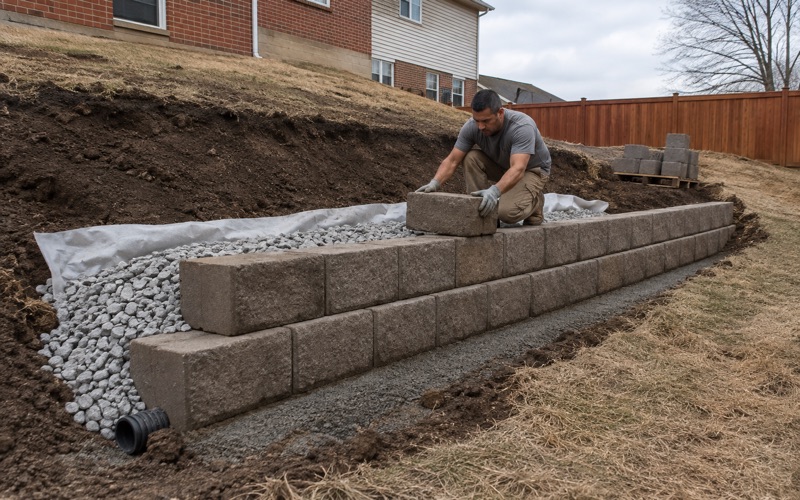
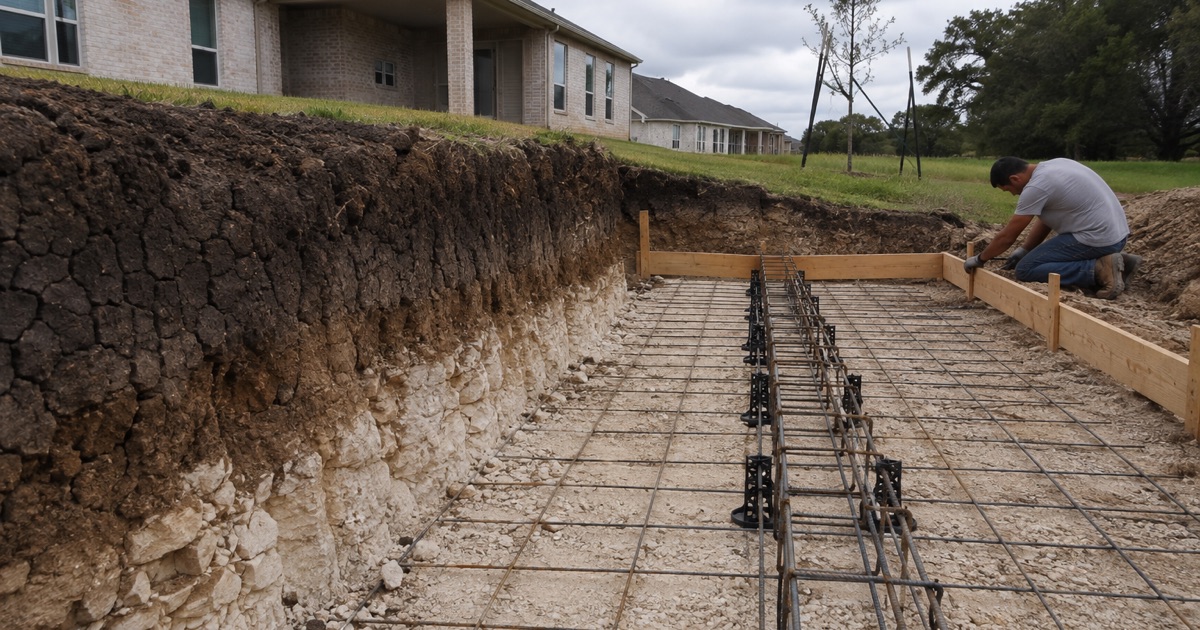
Those are not high-movement soils, so the design problem changes. Excavation slows, a trench for a grade beam or footing can meet refusal, and we price that as machine time rather than as clay mitigation.
Where the rock is indurated rather than weathered
The Rumple-Comfort rubbly association covers 4.5 percent of the city, with indurated limestone at 71 centimeters under Rumple and 30 centimeters under Comfort. Real gravelly loam adds 1.71 percent at 36 centimeters, and mapped rock outcrop totals 0.2 percent, so rock is a depth problem rather than a surface problem.
Comfort carries a representative plasticity index of 31 in the A horizon and 46 in the Bt, which on paper reads as serious shrink-swell ground, but its linear extensibility is 2.2 and 3.2 percent. The failure mode is bearing and refusal rather than heave, which is a different detail and a different price.
Gruene, and a hardpan at about thirteen inches
Gruene clay on 1 to 5 percent slopes covers 4.91 percent of the city and is the map unit where a machine meets hardpan inside the first foot and a half. It is a shallow Petrocalcic Paleustoll with a strongly coherent petrocalcic horizon at a representative 33 centimeters, and its surface horizon runs plasticity index 23 at linear extensibility 4.5 percent.
On a Gruene lot the excavation problem and the movement problem are not the same problem. Depth to refusal is no more constant than the clay is: 9.2 percent of the city carries indurated lithic bedrock, 12.0 percent paralithic bedrock, 4.2 percent a petrocalcic pan and 22.7 percent only noncoherent densic material, while 42.3 percent records no restriction at all.
Reading which half your lot sits on before anyone quotes
The site assessment we run first
Before we price a pour we establish which half the lot behaves like, from the mapped soil for the parcel, from what the excavation turns up and from the drainage already there. That is a short piece of work, and we would rather spend an hour on it than issue a number we have to take back.
We photograph subgrade, base, vapor retarder and steel before the pour, so what ended up under your slab is documented rather than remembered. On split ground that record matters more than usual, because the question a year later is always what was actually built.
Drainage design follows the subgrade, not the address
Conductivity separates the two halves sharply. The Vertisol map units run 0.21 micrometers per second through the profile, while the shallow calcareous units run roughly 2.7 to 9. A subgrade drainage detail that works on one side of the city is wrong on the other.
On slow-draining clay the aim is keeping moisture change away from the slab edge and building a base course that does not become a reservoir. On the calcareous units the water is gone and the attention moves to bearing, compaction and proctor density.
New construction, and what has not had time to fail yet
Housing here is young. The median year built is 2012, with 48.5 percent of the city’s 6,242 units going up during the 2010s and 9.2 percent in 2020 or later. Single-family detached houses are 85.8 percent of the stock, and 76.6 percent of occupied units are owner-occupied.
Flatwork on high-movement clay rarely announces a problem in its first decade, so many drives and patios here sit inside the window where nothing has shown up. That is not evidence the detail was right. When a young drive is already cracking on a Heiden or Houston Black lot, the ground is talking.
Designing and permitting one slab for two subgrades
Reinforcement, thickness and joint layout
Control joints are cut to the published schedule rather than by eye, at twenty-four to thirty-six times the slab thickness, capped at fifteen feet, with panels held inside a one-and-a-half-to-one aspect ratio. On the deep-clay side we work the tighter end of that range, so the slab chooses where it cracks rather than the ground.
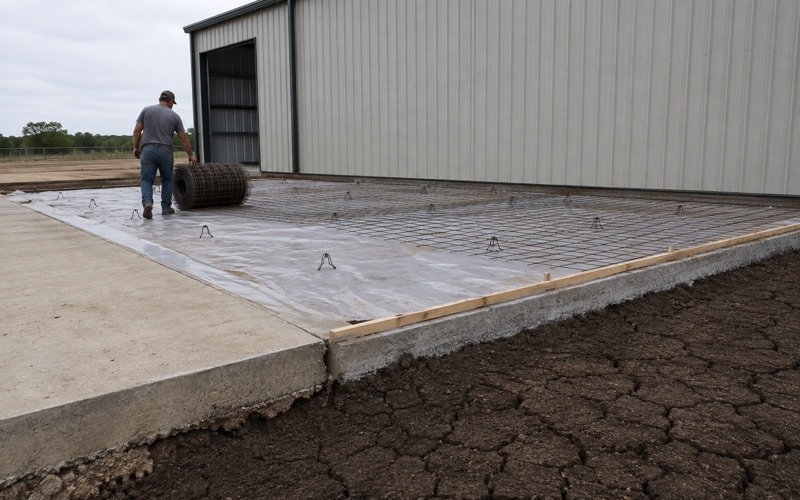
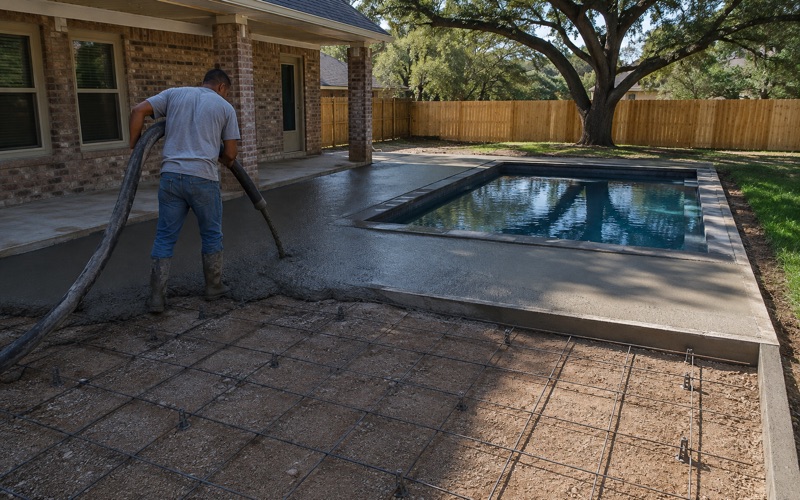
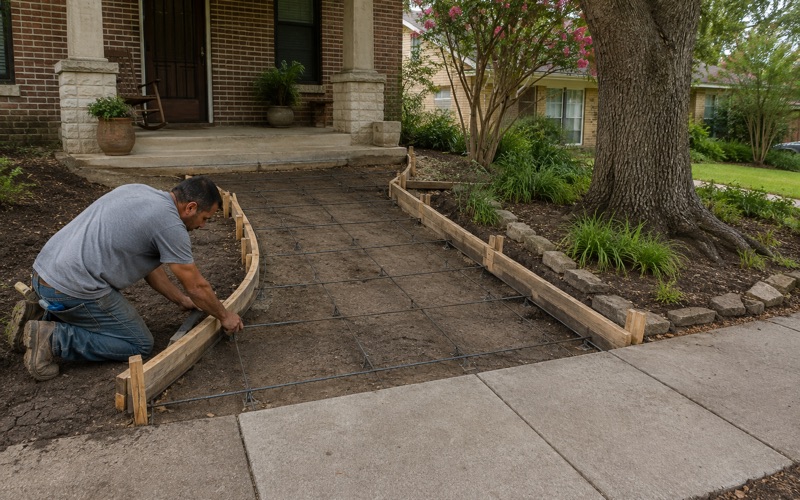
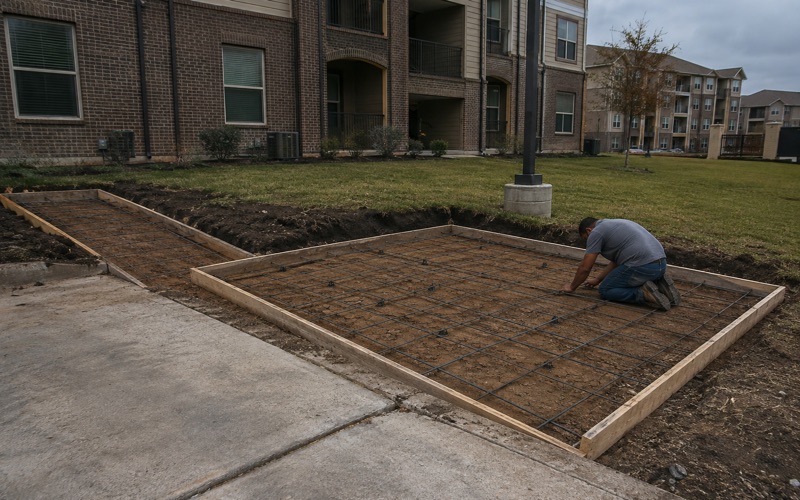
Reinforcement is specified for the ground beneath it, not for the invoice. Number four rebar on chairs at mid-depth is the usual answer where movement governs; where bearing over shallow rock governs, base course and slab thickness do more than the steel does.
The mix and the delivery ticket
Flatwork here is ordinary ready mix concrete, and what matters is compressive strength, water cement ratio and slump at discharge. We place at 4000 PSI where the ground works against the slab, and we plan hot weather placement around the load rather than the calendar, because the discharge limit is keyed to the temperature of the concrete itself.
You get a copy of the delivery ticket for every load. The county specification requires the machine-stamped batch time and date, the weights of cement, fly ash, sand and aggregates, and the admixture names and quantities, and an incomplete ticket is grounds to reject the load.
Permits, adopted codes and the two water quality tracks
The city lists foundation repairs, driveways and re-roofing among the situations where a permit is required, and applications go in through the MyGovernmentOnline portal to Development Services. UDC 3.05.09.B.1 states that a person commits an offense if the person constructs, reconstructs, relocates or in any way alters the design or operation of any driveway without first obtaining a building permit issued by the Building Official. Plan review typically runs 10 to 15 business days.
Review runs against the adopted codes, including the 2024 International Residential Code and the 2024 International Building Code, some amended by city ordinance. Buda is a one-permit city: subcontractors are named on the building permit application rather than pulling their own, and a licensed contractor must be registered with the city. Driveways are designed to the Engineering Criteria Manual rather than a dimensional table in the code.
Commercial approaches carry their own geometry. A driveway serving multi-family or nonresidential property must extend at least 15 feet onto private property from the right-of-way line before it meets any internal circulation drive. Table 35 requires stacking on any driveway serving 20 or more parking spaces, scaling to 100 feet at the highest tier.
Water quality then runs on two tracks. Development inside the Barton Springs/Edwards Aquifer recharge or contributing zones follows UDC 4.05.04, where impervious cover is capped at 15 percent on a net site area basis, and development outside them follows UDC 4.05.05. A development outside those areas at 25 percent impervious cover or less is exempt.
The Barton Springs/Edwards Aquifer Conservation District, or BSEACD, is one of the external agencies the city names for development work, alongside Hays County Development Services and the Hays County Transportation Department. We tell you which of those a job touches before it starts.
- 20+ Years in Business
- Insured
- Free Written Estimates